AI is not a buzzword anymore. How can it benefit your organization? Lately, the spotlight has been on Generative AI (GenAI), a form of artificial intelligence that doesn’t require structured data to provide insights.
Unlike traditional AI, which works with structured data like numbers, GenAI tools such as ChatGPT and Co-Pilot can analyze unstructured data, like documents. This allows users to quickly extract valuable insights from large amounts of information.
In healthcare, GenAI can help professionals by searching through medical records and documents to deliver relevant information. Physicians remain in control, of course, but save valuable time spent searching. Additionally, a GenAI chatbot can provide patients with reliable answers to frequently asked questions, enabling healthcare providers to focus on more complex cases.
AI holds significant potential for healthcare. For example, the Dutch government aims to halve administrative workloads in the healthcare sector by 2030. How can AI contribute to this goal?
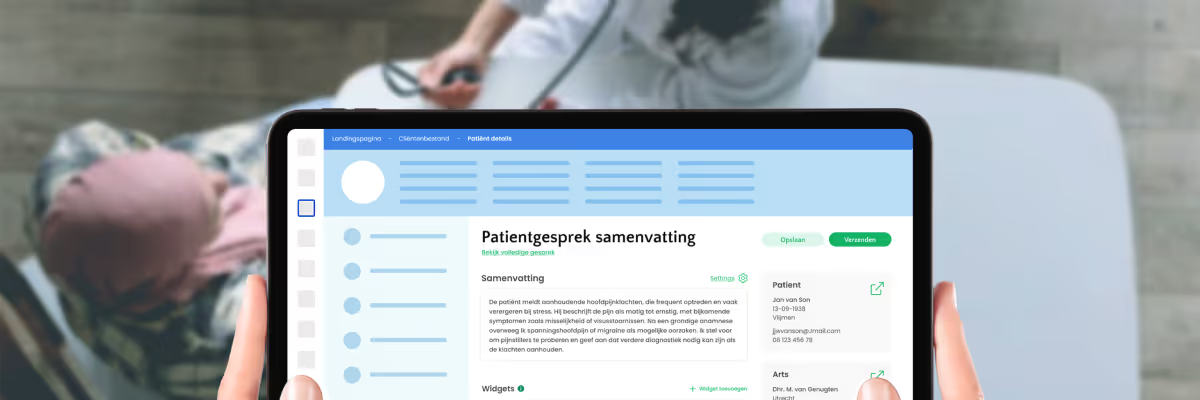
One of the most time-consuming administrative tasks in healthcare is documenting consultations or patient interactions. For every two hours of direct care, approximately two hours of administrative work is required. AI can drastically simplify and reduce this process by:
Example: Squad Apps has developed a template for this process, reducing administrative time from two hours to just 15 minutes!
According to the Dutch Healthcare Authority (NZa), billing and claims management are among the largest administrative burdens in the healthcare sector. By leveraging AI technology, such as Optical Character Recognition (OCR), a significant portion of this process can be automated. Repetitive and time-consuming tasks, such as retrieving and processing invoices from emails or approving standard invoices, can be handled by AI. This allows employees to focus on exceptions and personalized customer contact, where their real value lies.
The updated process would look as follows:
This streamlined process not only saves time but also improves the efficiency and accuracy of invoice processing.
AI has the potential to improve healthcare in several ways:
It’s important to recognize that AI solutions are new, and their success depends on agility during implementation. Solutions must align with end-user needs and be adaptable based on ongoing results.
Depending on your healthcare organization’s situation, we can work together to determine where AI can add the most value. Whether you’re a small organization needing a complete EPD solution or a large institution with specific integration requirements, we’re here to help.
Curious about the possibilities of (Gen)AI for your organization? Fill out our contact form and we’ll get in touch within two business days!
PS: Did you know the Dutch government supports projects like these? The Stimuleringsregeling Technologie in Ondersteuning en Zorg (STOZ) offers financial aid for digital healthcare solutions. For more information, visit the Dutch government’s website.
You might have questions. Can't find what you're looking for? Reach out to us!

Low-code platforms with AI and machine learning integration enable healthcare organizations to innovate more quickly without having to replace their entire existing IT landscape. Mendix acts as a layer that connects various data sources, such as Electronic Client Records (ECRs) and laboratory systems, to intelligent algorithms. This makes it possible to bring complex AI models to frontline healthcare professionals through user-friendly applications.
Yes. Through machine learning, patterns can be identified in large volumes of data. This enables healthcare organizations to better predict, for example, patient inflow at emergency departments or detect early signs of patient deterioration. These predictive analytics capabilities support better planning, more efficient resource allocation, and proactive care delivery.
An AI solution is only successful if healthcare professionals enjoy using it and trust its value. That is why we involve end users directly in the development process through an Agile approach. We focus on creating intuitive Mendix interfaces that seamlessly fit into daily workflows, ensuring that the technology supports healthcare professionals rather than slowing them down.